editorial guide · September 29, 2026
Dream11 App guide: Dream11 captain matrix, ceiling and venue
Written by the Dream11 App Editorial Team
This guide has been reviewed for clarity, India-market accuracy, and consistency with public reference pages.
Updated
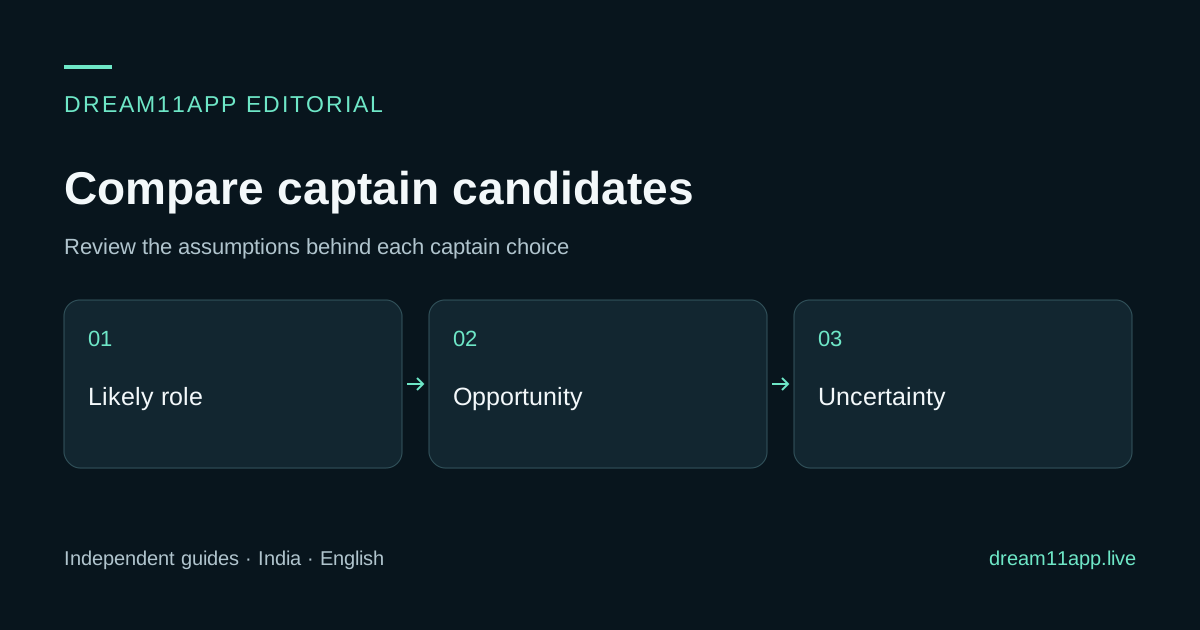
A Dream11 captain decision can be organized around participation, role stability, scoring opportunity and match conditions. The matrix below is an editorial decision aid, not a validated prediction model or a promise of accuracy. Use current match information and the multiplier actually shown by the contest before applying it to a selection. This Dream11 App guide explains the reasoning method only; it does not promise a score or a captain result.
Start with eligibility and participation
Remove candidates whose participation is not supported by the information available at your decision time. Distinguish a confirmed XI from a squad announcement or predicted lineup. If the deadline arrives before confirmation, record that uncertainty rather than presenting the pick as certain.
Check the provider’s captain and vice-captain rules. A common teaching example uses 2× and 1.5×, but the actual contest sheet controls. A multiplier magnifies a player’s score; it does not improve the player’s opportunity to bat, bowl or field.
Use a qualitative matrix
| Dimension | Evidence to record | A reason to reconsider |
|---|---|---|
| Participation | Official lineup or reliable availability information | Unconfirmed selection or restricted workload |
| Role stability | Expected batting position, overs and keeping duties | Recent role changes or likely rotation |
| Scoring routes | Events the role can plausibly produce | Reliance on one rare event |
| Conditions fit | Current pitch, weather and match context | Conditions contradict the assumed role |
Use words such as strong, uncertain and weak with a short explanation. Adding arbitrary numerical ratings can create false precision. If you choose a score for your personal notes, define it consistently and do not present the sum as a proven probability.
Compare two hypothetical candidates
Suppose Candidate A is expected to open the batting but has no bowling role. Candidate B is expected to bat lower and bowl a full workload. A may have more batting opportunity; B may have multiple routes to points. Neither is automatically superior. The scoring sheet, expected match length and certainty of the bowling role matter.
Now suppose B’s team has added another specialist bowler and B’s workload becomes uncertain. That changes the reason for the pick, even if the player’s reputation remains the same. Revisit the role assumption instead of mechanically retaining the higher rating from an earlier worksheet.
Ownership is context, not ability
A displayed selection percentage can help describe how common a pick is, but it does not measure the chance of scoring well. A less popular captain is useful only if there is a sound opportunity case. Do not claim that a certain ownership band or contest size guarantees rank separation or a prize.
If the provider does not show a reliable percentage, omit that input. A transparent decision based on known roles is more useful than a fabricated number. The team-selection guide explains how to keep an evidence sheet for the whole XI.
Recheck and review
Before the deadline, confirm that the intended captain and vice-captain were saved on the entry, not merely selected in an unsaved draft. Review any new participation information and the time remaining before making changes. The toss guide helps identify which assumptions deserve revision.
After the match, compare the expected role with actual involvement. A player can perform poorly despite a reasonable role assessment. Conversely, an unsupported choice can succeed once. Separate decision quality from a single outcome and use the scoring walkthrough to check the event total.
Make ceiling and venue part of the evidence sheet
In this framework, “ceiling” means a plausible high-outcome scenario for a player’s role. It is not a measured maximum, an expected score or a probability. Write what would have to happen for that scenario: enough time at the crease, a genuine bowling allocation, a relevant fielding role or several eligible events. Then record what could prevent those opportunities.
A venue name alone does not complete that reasoning. Check whether the current match report concerns the same surface, format and conditions as the historical comparison. A small sample from a different pitch or season may not describe today’s role. If the information is missing, mark the venue input unknown rather than filling the cell with a confident label.
| Hypothetical candidate | Plausible scoring opportunity | Venue or match evidence to check | Failure branch |
|---|---|---|---|
| A: confirmed opener, no bowling role | Time at the top of the order if the innings lasts | Current surface report and whether the match length changes | Early dismissal or a short chase limits batting events |
| B: confirmed all-rounder | Batting plus bowling, if both roles are expected | Team balance and evidence for the actual overs allocation | Another specialist takes overs; the two-route case weakens |
| C: confirmed bowler used late in an innings | Wicket opportunities if that phase is reached | Evidence of the role and likely innings length | Shortened play, an early finish or changed allocation removes the assumed phase |
These are fictional role descriptions, not recommendations for named players. None supplies a “best captain today” answer. Compare the actual fixture against its Dream11 scoring rules before deciding which events the role could earn points for.
Walk through a change without rebuilding the whole team
Suppose both A and B are confirmed and your original captain case favours B because two scoring routes appear available. A subsequent verified team announcement includes another specialist bowler, but does not say how overs will be distributed. Change B’s bowling-workload cell from supported to uncertain. Do not automatically replace it with zero, and do not retain a confident full-workload assumption.
Now compare A’s remaining batting opportunity with B’s supported roles. If the only case for B depends on overs you cannot establish, the rationale for the original preference has weakened. If later reliable information supports B’s bowling role, restore that evidence with its time and source. If the deadline arrives first, make the decision from what you know then; later performance cannot retroactively supply missing evidence.
If neither candidate has supported participation, return to the team-selection eligibility checks. A captain matrix should follow a valid team, not conceal an unresolved XI. If the choice concerns a room’s rules or entry conditions, use the contest-format comparison before applying the player comparison.
Understand the arithmetic of a captain switch
Here is a retrospective teaching example, not a forecast. Suppose A finishes on 40 base points and B on 70, and the contest uses captain 2× and vice-captain 1.5×. A as captain and B as vice-captain contribute 40 × 2 + 70 × 1.5 = 185. Reversing them gives 70 × 2 + 40 × 1.5 = 200. The difference is 15 points across those two players; the other nine contributions are unchanged.
You do not know those final base scores before the match. The example shows why the saved assignments matter, not how to predict the higher scorer. A negative base score would also be multiplied under those example rules. Use the event-by-event scoring walkthrough to check the base score before attributing a discrepancy to the captain setting.
Finish with a saved assignment and a reviewable reason
Before lock, reopen the relevant entry and verify which player is captain and which is vice-captain. Check that the intended team, fixture and entry are the ones being edited. A change in a draft does not establish that every entry using an earlier team has changed. Read the provider’s actual saved-entry state rather than assuming automatic synchronization.
If saving fails, preserve the last confirmed state and the error. Repeated taps are not proof of acceptance. The deadline and failed-save checklist helps decide what can still be checked before the displayed lock. After play, record whether the role assumption held, which uncertainty mattered and whether the submitted assignment matched your intention. Review that process separately from the final rank.
Captain questions
FAQ: Does the highest matrix score always identify the best captain? No. The framework records assumptions and uncertainty; it has no claimed predictive guarantee.
FAQ: Should I always choose an all-rounder? Only if the expected batting and bowling roles are real for that fixture and fit the scoring rules. The role label alone is insufficient.