editorial guide · September 29, 2026
Dream11 App guide: contest room, mega, small league, H2H
Written by the Dream11 App Editorial Team
This guide has been reviewed for clarity, India-market accuracy, and consistency with public reference pages.
Updated
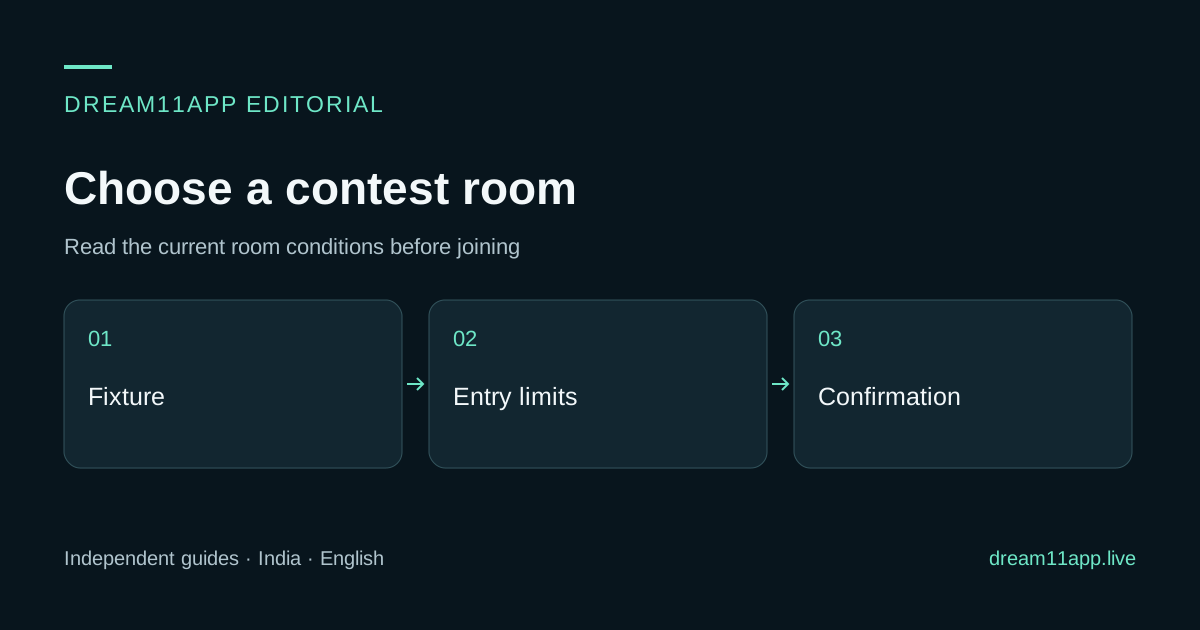
A Dream11 contest room should be chosen after you understand the fixture and the room’s current conditions. Compare access, field size, entry limits, scoring, deadline and rewards before confirming the team. The official listing reviewed on 2 November 2026 describes free public/private contests; historical paid-room examples do not establish present availability. Dream11 App readers should confirm the contest card on their own screen before joining, because room rules change between fixtures.
Read the room card in a fixed order
First confirm the fixture and date. Next read entry conditions and the permitted number of teams per user. Then inspect the scoring rules, deadline and reward distribution. Finally check whether the room can change, cancel or remain unfilled. Keep the actual terms shown rather than relying on a generic label such as mega or guaranteed.
If any important condition is absent, look for the provider’s linked rules or ask support. A large headline number does not explain tie treatment, eligibility or whether a reward is a cash amount, an in-app item or another benefit.
Match the room to your purpose
For learning, a currently available free room allows you to compare your selection assumptions with the event breakdown. A private room can support play with people you know, provided the invitation and rules are clear. A smaller field may be easier to review, but field size alone does not establish the skill of the entries or your probability of success.
A large field may include multiple teams from the same user or repeated combinations. That affects how you interpret the leaderboard. Do not assume that a stated number of entries equals the same number of independent opponents.
Distinguish a reward from profit
If considering a historical paid-contest example, subtract the entry cost from an award before calling it a gain. A finishing position that receives a reward may still return less than the amount paid. Any taxes or other deductions need separate treatment. The contest-types article provides a fully declared arithmetic example.
A guaranteed pool, where a provider uses that term, does not guarantee your result. Read the exact condition being guaranteed. Never infer a personal win probability from the fraction of places receiving a reward.
Confirm the team and invitation
Check that the intended team is attached to the chosen room. A saved team can exist without a confirmed entry. For a private invitation, verify the organizer, provider, fixture and remaining availability. A copied code from another fixture or an expired invitation may fail even when the characters are correct.
Use the league invitation guide for code problems. Do not pay someone to activate an invitation, and do not send an OTP or password to a person claiming to manage the room.
Handle changes and review the choice
If a match is delayed, shortened or rescheduled, inspect the provider’s notice for that contest. Sporting schedule changes do not by themselves establish how the fantasy entry is treated. Preserve the entry reference and the message before contacting support.
After completion, review whether the format helped you understand the result and whether you followed your time and spending limits. Do not increase participation simply to recover an unfavorable outcome. The responsible-use guide covers limits and account controls.
Room-choice questions
FAQ: Is a small league always safer than a mega contest? The label alone cannot establish risk, opponent skill or outcome probability. Compare the actual conditions and your purpose.
FAQ: Can I use the same team in several rooms? Follow the current provider’s entry rules and verify each confirmation. Do not assume one saved team is entered everywhere.